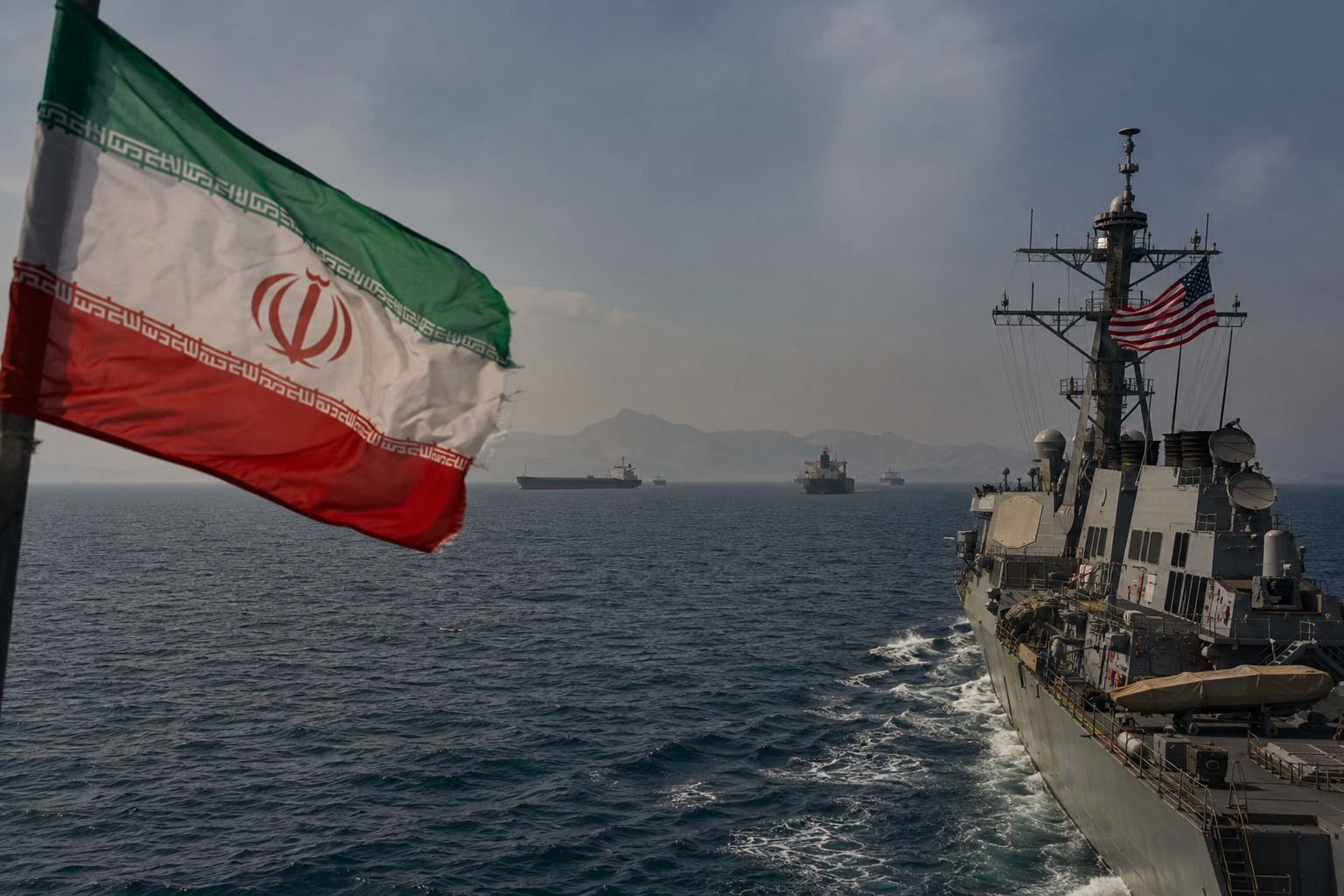
The idea survived about 24 hours. On Monday, President Donald Trump announced that the United States would reinstate its naval blockade of Iranian ports and, separately, collect 20 percent on every cargo crossing the Strait of Hormuz, styling the country as the waterway's guardian and the fee as reimbursement for the work of keeping it safe. By Tuesday afternoon, the blockade was real and the fee was not.
U.S. Central Command confirmed that American forces resumed blocking maritime traffic to and from Iranian ports and coastal areas at 4 p.m. Eastern, restoring a cordon that ran from April 13 to June 18 before the interim agreement briefly lifted it. NPR reported that CENTCOM instructed mariners approaching the Gulf of Oman and the strait to raise U.S. naval forces on bridge to bridge channel 16, with a formal notice to commercial shipping to follow.
The fee died quietly. Trump wrote on Truth Social that after productive conversations with Middle East leadership, he had decided to replace the reimbursement charge with trade and investment deals Gulf states will make in the United States. He told reporters in the Oval Office that kings and emirs had called offering the alternative, and that he preferred it because, as he put it, nobody should be able to charge a fee for the strait. That sentence carries the entire policy inside it. Washington has argued for five months that Hormuz belongs to no one and can be taxed by no one. For one day, Washington proposed to tax it.
CNBC reported that Trump backed down after the shipping industry largely opposed the charge and after the International Maritime Organization, a United Nations agency, said mandatory tolls in the strait are illegal. No figures, timelines or signatories for the replacement investments have been provided, and it is not clear whether they represent new money or commitments already announced after Trump's trip to the region last year.
Tehran caught the contradiction before Washington dropped it. Iranian Foreign Minister Abbas Araghchi answered the original announcement by agreeing that safe passage deserves compensation, then writing that Iran has always been the guardian of the strait and will remain so forever, according to NPR. He added that 20 percent was too much and that Iran would be fair. Parliament speaker Mohammad Bagher Ghalibaf posted an image of the June memorandum with part of Point 5 highlighted and declared the era of one sided deals over.
Point 5 is where the war now lives. The clause obliges Iran to use its best efforts for the safe passage of commercial vessels. Michael Singh of the Washington Institute for Near East Policy told NPR the wording tracks closer to what Iran wanted, because it hands responsibility for the strait to Tehran rather than restating that the channel is international water. Fourteen points, a 60 day clock, and one phrase asked to hold up the whole structure.
While the interpretations diverged, the shooting did not. Central Command said it struck coastal defense systems, missile and drone sites and maritime capabilities across Iran on Tuesday, and Iran acknowledged the strikes without releasing casualty or damage figures. The Revolutionary Guard said it hit two non compliant supertankers in the strait. The United Arab Emirates defense ministry said two of its tankers were struck by Iranian cruise missiles in Omani waters, killing one person, NPR reported. Jordanian state media said air defenses intercepted four missiles entering Jordanian airspace early Tuesday, and Bahrain sounded sirens and told residents to seek shelter. Iranian state media reported explosions at Bandar Abbas, Ahvaz, Qeshm Island and Bushehr. Qatar called the attacks on Jordan, Bahrain and Kuwait a violation of sovereignty and pressed for diplomacy.
The market response was the most revealing detail of the day. According to CNBC, West Texas Intermediate rose 1.5 percent to close at $79.34 a barrel and Brent gained 1.72 percent to settle at $84.73, firm but far below the roughly $120 the war produced at its worst. The Energy Department told CNBC that 8.5 million barrels moved through the strait on Sunday alone despite the fighting. Traders are pricing risk, not catastrophe. The oil is still moving, in smaller volumes and under worse odds. Kpler counted 22 crossings on July 9 against 147 the day before the war began in February.
A fifth of the world's traded crude and gas once passed through this channel free of charge and free of permission. Both governments now claim the authority to decide who goes through. Neither has moved, and the 60 day window for a permanent agreement is roughly half gone.
Regional mediators including Oman, Qatar and Pakistan are still working to restart talks, and two regional officials told the Associated Press that Pakistan led mediation is running around the clock. Trump told Fox News on Tuesday evening that more strikes are coming, that bridges and power plants could be targets by next week without negotiations, and that his last contact with Iranian negotiators had come earlier that same day. He also said he was not interested in talking now, because they lie. Lebanese and Israeli delegations met in Rome on Tuesday and were scheduled to continue U.S. mediated negotiations Wednesday.
Sources: Associated Press, NPR