The number was good. That is the problem with it.
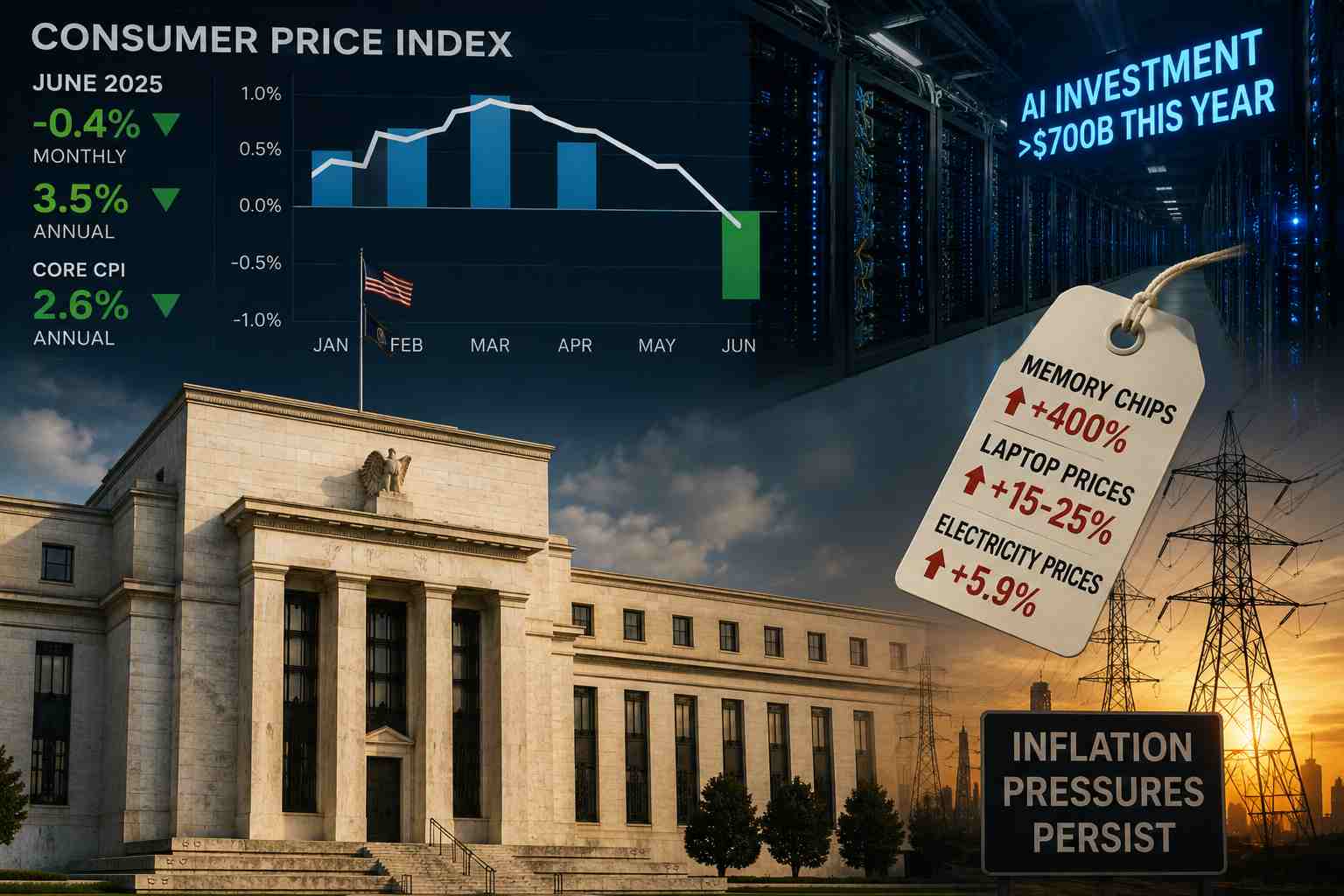
The Bureau of Labor Statistics reported Tuesday that consumer prices fell 0.4 percent in June after rising 0.5 percent in May, the largest one month decline since April 2020, when the economy had simply stopped. Annual inflation eased to 3.5 percent. Core prices, which strip out food and energy and are the figure the Federal Reserve actually watches, were unchanged for the month, putting the 12 month core rate at 2.6 percent.
CNBC reported that economists surveyed by Dow Jones had expected a 0.2 percent monthly decline and a 3.8 percent annual rate. The report undershot the forecast in nearly every line. Treasury yields fell sharply. Stock futures rose. Traders trimmed the odds of a September Fed rate hike to 63 percent from better than 75 percent a day earlier, according to CME FedWatch data cited by CNBC. The Fed's target range sits at 3.5 to 3.75 percent.
Then look at what did the work. The BLS said the energy index fell 5.7 percent in June, its own biggest monthly drop since April 2020, and that energy was the largest single contributor to the decline, more than offsetting increases in shelter and food. Gasoline is still up 26.7 percent over 12 months. June was the month the ceasefire held and oil sagged roughly 25 percent. The war resumed last week. The blockade came back Tuesday afternoon. The report describes a country that no longer exists.
Fed Chair Kevin Warsh, in remarks prepared for Congress and quoted by CNBC, waved off the celebration before it started, saying some would read the morning's data as mission accomplished and adding flatly that this was not his view.
He has a second reason for caution, and it has nothing to do with Iran.
The buildout nobody voted for is now in the price index
Investment in data centers will likely top $700 billion this year. Alphabet, Amazon, Meta and Microsoft alone are expected to spend roughly $720 billion, most of it on the facilities that train and run artificial intelligence. Those buildings eat semiconductors, and the supply has not kept up. Economists at JPMorgan Chase estimate some computer memory chips will have risen as much as 400 percent between 2024 and the end of this year.
That cost has stopped being an industry story. Apple raised laptop and iPad prices by roughly 15 to 25 percent last month, pushing a topline MacBook to $1,999 from $1,699, and said in a statement that it had never seen a component price climb this fast. Microsoft announced the same day that the Xbox will cost $100 more by August 1, citing memory chips. Sony raised PlayStation prices. Dell and HP raised laptop prices. Analysts at Evercore ISI wrote that the spillover of AI costs into consumer prices is still in its early stages.
Electricity is the slower and more permanent version of the same squeeze. BLS data showed electricity prices up 5.9 percent in May from a year earlier, outpacing overall inflation at 4.2 percent, after annual gains had settled near 2 percent in early 2025. Chip prices may peak this year. Power will not. Goldman Sachs forecast in February that electricity prices will rise 6 percent this year and next, and an above average 3 percent in 2028.
Why the Fed cannot simply look past it
Central banks are built to ignore one time shocks. Tariffs, a war, a bad harvest, the textbook answer is to wait them out rather than raise rates into a supply problem. Abiel Reinhart, an economist at J.P. Morgan, told the Associated Press that one or two such shocks are something policymakers can live with, and that a sustained series of them becomes a different question.
That is roughly the situation. Tariffs, then a gasoline spike, now a hardware and electricity spike, arriving in sequence into an economy that has run above the Fed's 2 percent target for more than five years. Many economists expect the AI buildout alone to add about half a percentage point to core prices by year end, enough to cancel out cooling rents and fading tariff effects. Core inflation by the Fed's preferred measure was 3.4 percent in May.
New York Fed President John Williams, vice chair of the rate setting committee, said last week that a sustained demand impulse outrunning supply is precisely the scenario in which a central bank does not look through the increase. He has voted to hold rates steady. The comment marks the door he would walk through if he changed his mind. Minutes from the June 16 and 17 meeting, released last week, show many colleagues share the worry.
Warsh has argued that AI should eventually make the economy more efficient and therefore push prices down. On July 1 he acknowledged that the investment is currently boosting demand, and declined to say by how much.
So the June report lands as a snapshot of a calmer month, not a forecast. Dario Perkins, an economist at TSLombard, put the near term plainly this week, writing that what AI is doing to inflation right now is inflationary, not deflationary.
Sources: Associated Press, CNBC