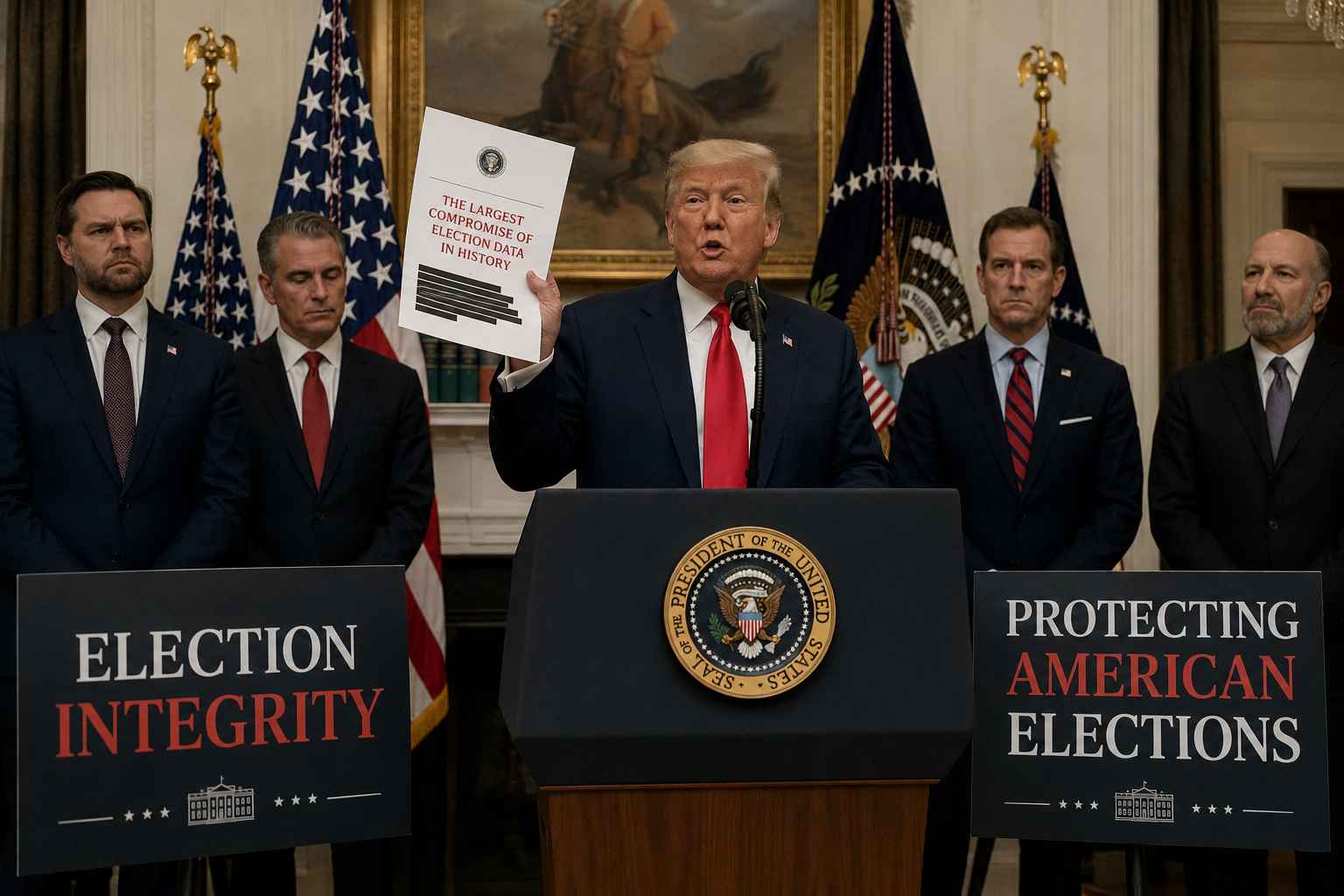
For roughly half an hour on Thursday night, President Donald Trump stood in the White House, flanked by his senior team, and told the country its elections could not be trusted. Journalists were kept from asking a single question. Two of the three broadcast networks he later threatened to punish declined to carry him live.
The speech, delivered a little under four months before midterm elections that will decide control of Congress, revived Trump's long-running grievance over his 2020 loss to Joe Biden and gave it a new antagonist: China. But the most striking feature of the address may be what happened after it the near-silence from Beijing, and the gap between what Trump asserted and what his own declassified documents actually show.
The claim
Trump said newly declassified intelligence hundreds of pages, many heavily redacted, released by the White House as he spoke proved that China had carried out "the largest compromise of election data in history," beginning with the 2020 cycle. He put a number on it: 220 million voter files, drawn from 18 states, "bought, stolen or hacked" by Beijing. He alleged China had also tried to sway American business leaders and journalists, and that a "deep state" inside his own first-term government had buried the warning.
He widened the aperture from there. American voting machines, he said, are "extremely exposed" to Russia, China and Iran. He cited a Michigan registration-fraud investigation he claimed the FBI had smothered, and a Department of Homeland Security figure of 278,000 non-citizens registered to vote. At no point, across any of these claims, did he present evidence that a single vote had been changed, a tabulation altered, or a machine actually breached.
The record
The trouble is that Trump's own government has already examined much of this. A March 2021 assessment from the National Intelligence Council released under his successor but built on career analysts' work concluded with "high confidence" that China did not interfere in the 2020 election. Beijing weighed an influence effort, the report found, but never deployed one, calculating that neither a Trump nor a Biden victory was worth the risk of getting caught.
The declassified files Trump waved Thursday do contain a dissent: a minority view, held chiefly by the National Intelligence Officer for Cyber, that China took some steps to undercut Trump's reelection, largely through social media and public statements. But the officers who held that view rated their own confidence as low to medium a footnote, not a finding. And much of the "stolen" voter data Trump described turns out to be the kind of information, names, addresses and party registration, that many states make publicly available by law.
The quiet from Beijing
If Trump's speech was built to provoke China, China declined to take the bait. A foreign ministry spokesman, Lin Jian, called the allegations "entirely fabricated" and "malicious smears," insisting Beijing "has never" interfered in U.S. elections. But the response stopped there no demands for a retraction, no threats of retaliation, and, tellingly, near-silence from the nationalist commentators who usually seize on such moments.
Analysts read that restraint as strategy. Beijing appears to have concluded the speech was aimed at American voters, not at China, and it has reasons to protect a fragile truce: a May summit between Trump and Xi Jinping, a tariff détente struck last autumn, and a Xi visit to the White House now penciled in for September. With China's economy growing at its slowest pace in three years and its exports drawing pushback from Europe to Southeast Asia, access to the U.S. market is worth swallowing an insult. The détente holds for now on a single condition: that Trump's words do not turn into fresh action, such as new tariffs, which China has signaled it would answer in kind.
The audience at home
Domestically, the speech landed as what critics called an effort to pre-discredit an election Republicans may lose. It arrived alongside a Washington Post–Ipsos poll putting Trump's approval at 37 percent, with voters uneasy about the cost of living and a war with Iran. It closed with a pitch for the stalled SAVE America Act proof-of-citizenship registration, photo ID, and sharp limits on mail voting which remains short of the votes to clear the Senate.
Democrats responded in force. Chuck Schumer called it "blatant lies"; Hakeem Jeffries called Trump "unhinged"; Kamala Harris said flatly, "We won, and he lost"; and Gavin Newsom likened the address to "the ramblings of a mad king." Even the loyalty inside the administration showed a seam: Vice President JD Vance, widely seen as maneuvering toward 2028, said days earlier that of course Republicans would accept the midterm results a notably lighter touch than Trump's warning that the party "will never win another election" without the SAVE Act, before Vance closed ranks online after the speech.
What to watch
The address changed no intelligence assessment and moved no stalled bill. Its real test is external: whether Trump treats "the largest compromise of election data in history" as a talking point or a trigger. Beijing has bet on the former. The next few weeks and whether that September White House visit survives will show whether that bet was sound.
Sources
BBC News, "Trump accuses China of 2020 election interference in primetime address." https://www.bbc.com/news The New York Times, "China Rejects Trump's Election-Meddling Claim but Treads Carefully" (Asia Pacific), July 17, 2026. https://www.nytimes.com/2026/07/17/world/asia/china-trump-meddling-election.html USA TODAY, "Takeaways from Trump's primetime address on election security," July 16–17, 2026. https://www.usatoday.com/news/politics/donald-trump/