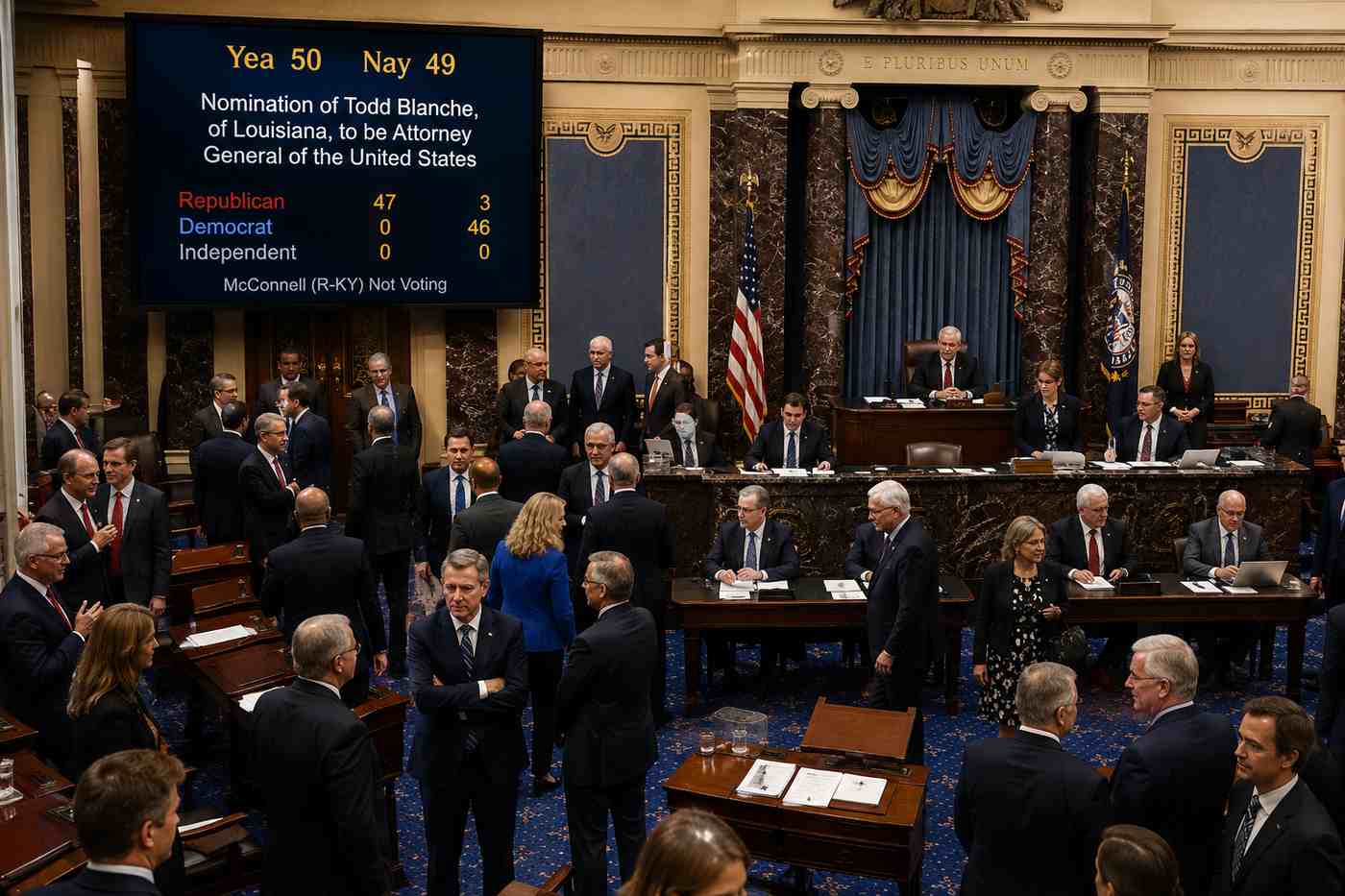
WASHINGTON — The Senate spent Friday night and the small hours of Saturday clearing a backlog it had been unable to move for months, handing President Donald Trump three significant wins and one pointed defeat before senators scattered for a five-week recess with midterm elections roughly three months away.
The centerpiece came at the end. CBS News reported that the Senate confirmed Todd Blanche as attorney general in a 50 to 49 vote early Saturday, installing the president's former defense lawyer as the nation's top law enforcement official. Republican Sens. Susan Collins of Maine and Lisa Murkowski of Alaska joined every Democrat in opposition, and with Sen. Mitch McConnell of Kentucky absent, the decisive vote belonged to Louisiana Republican Bill Cassidy, who announced his support Friday morning. CBS News
Blanche, 52, becomes the 88th attorney general. CNN reported that since Trump returned to office, Blanche has been instrumental in reshaping the Justice Department in the president's image, moving from the face of Trump's legal defense to the face of his retribution campaign, putting forward legal arguments expanding presidential power and overseeing mass firings of experienced prosecutors and longtime officials. CNN also reported that his effort to win over Murkowski included a two-day trip to Alaska, two settlements and the dropping of two lawsuits, none of which moved her. CNN
What nearly sank the nomination
The fight was not principally about Blanche's past as Trump's criminal defense attorney. It was about money and immunity.
CBS News reported that Democrats and some Republicans objected to the Justice Department's creation of a $1.8 billion "anti-weaponization" fund to pay people who alleged they were wronged by the federal government, a program that emerged from a May settlement resolving Trump's $10 billion civil suit against the Internal Revenue Service over the leak of his tax returns. Senators also pushed back on a second provision granting broad immunity to Trump, his family and his businesses from tax audits and investigations. CBS News
The nomination moved only after Blanche gave ground. According to CBS News, following weeks of negotiations, Sens. John Cornyn of Texas and Thom Tillis of North Carolina reached an agreement under which Blanche issued an order rescinding his May directive establishing the fund and clarified that the immunity deal applies only to claims arising from already-filed returns and covers the president, his two oldest sons and the Trump Organization. CBS News
Collins said she would oppose him anyway, citing actions that she said had further eroded the department's independence. CBS News
The Epstein files also shadowed the vote. CBS News reported that Blanche met with survivors of Jeffrey Epstein's crimes at the Justice Department last month after Tillis conditioned his support on such a meeting, and that some of those survivors criticized the session afterward, with one calling it a check-the-box exercise designed to secure votes. CBS News
White House press secretary Karoline Leavitt called the confirmation a major win for the president and the country in a statement to CBS News, and said Blanche would serve with an unwavering commitment to law and order. Vice President JD Vance congratulated him on X.
A sanctions bill a year in the making
Hours before the Blanche vote, the Senate passed the Russia sanctions package that had eluded it for more than a year. CNN reported that the bill passed 86 to 11 and is named for the late Sen. Lindsey Graham, who spent over a year negotiating it. It would impose mandatory sanctions on top Russian officials including President Vladimir Putin, on oligarchs, state-owned enterprises and foreign companies supporting Russia's defense industrial base, and would allow tariffs of up to 100 percent on the five largest buyers of Russian crude and natural gas, including China and India, with U.S. Trade Representative Jamieson Greer setting the final level. CNN
CBS News reported that the measure gives the president authority to waive the sanctions if he certifies to Congress that doing so serves the national interest, and that the effort gained momentum after Graham's sudden death in July. Opposition collapsed late. Kentucky Republican Rand Paul won a vote on an amendment stripping the tariff authority, which failed, and Georgia Democrat Raphael Warnock dropped his objection after securing a written commitment from Greer, according to CBS News. CBS News
CNN reported that Ukrainian President Volodymyr Zelensky watched the first procedural vote from the Senate gallery in the hours after Graham's funeral in Washington. The bill now goes to the House, which is in recess until September. CNN
Funding, early and unusually
The Senate also moved to take a shutdown off the table before voters go to the polls. The Associated Press reported that senators approved a short-term funding measure 90 to 6 in an overnight vote, extending federal agency funding through December 11, and that the timing was unusual because Congress normally waits until the final days before a deadline rather than acting nearly two months ahead of the September 30 end of the fiscal year. The AP noted that the margin reflected lingering damage from two historic shutdowns over the past year.
Democrats extracted concessions. According to the AP, they secured language barring any transfer of money to the Border Patrol and rejected a White House request for $1 billion in early work on a new "Trump-class" battleship. Senate Democratic leader Chuck Schumer told the AP the only person who wants the ships is the president, so he can put his name on them.
Two other provisions drew fights. The AP reported that the bill delays a national ban on most intoxicating hemp products by one month, drawing objections from Sen. Ted Budd of North Carolina, who cited a nearly tenfold increase in cannabis-related emergency room visits by minors in his state since 2017. Budd's effort to strip the delay failed. The bill also blocks, for the duration of the patch, a proposed rule requiring senior political appointees to review federal grants before they are awarded. Collins, who chairs the Appropriations Committee, told the AP she had never seen a proposed rule generate as many negative comments.
The House must still approve the measure when members return.
The one that failed
Trump's top legislative priority did not survive the night. Fox News reported that Senate Democrats, including Schumer, blocked a stripped-down voter identification bill from Ohio Republican Jon Husted that would have barred election officials from issuing federal ballots to voters without valid identification, with acceptable forms including an unexpired driver's license, a state ID card, a passport, a military or veteran ID or a tribal ID. The measure drew 52 votes, short of the 60 needed to advance. Fox News
Fox News noted that Schumer said in March that Democrats support voter ID and pointed to its inclusion in earlier Freedom to Vote legislation, and that his entire caucus voted against the Husted bill regardless. Identification is already required in 36 states, 23 of which require photo ID. Republicans had sought the vote as a substitute for the full SAVE America Act, which leaders acknowledged lacked the votes. Fox News
Senators are due back in September, with the funding bill, the sanctions package and the elections fight all still unresolved in the House.
Reporting from CBS News and The Associated Press, Fox News.