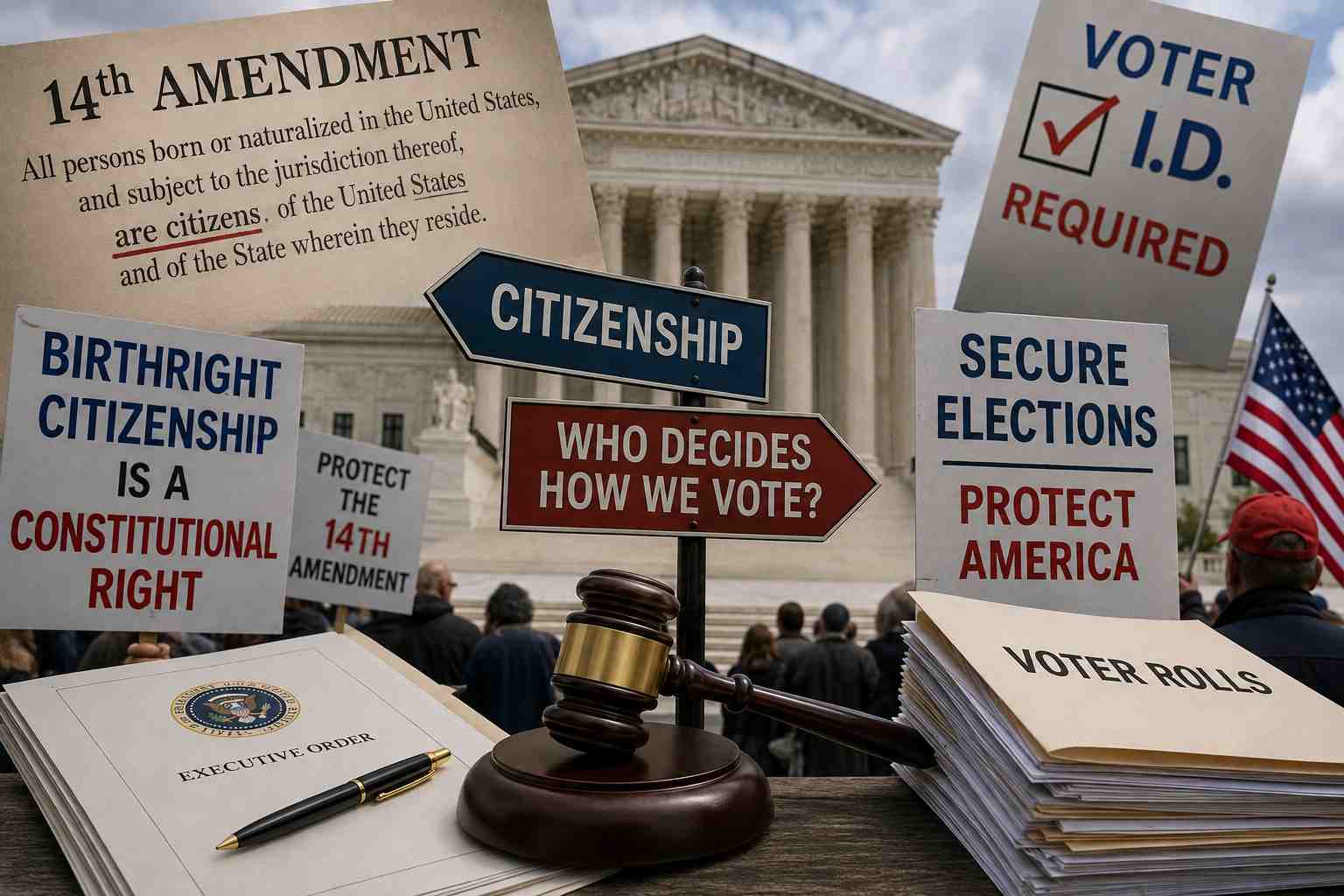
WASHINGTON — Two constitutional questions that seemed settled a generation ago are once again live: who is an American citizen at birth, and who decides how Americans vote. Both moved this week, and both are headed back to the courts.
A second attempt on the 14th Amendment
CBS News reported that President Donald Trump signed two executive orders Thursday seeking to deny citizenship to some children born in the United States, roughly five weeks after the Supreme Court struck down his earlier order aiming to end birthright citizenship. Trump told reporters at the Oval Office signing that the ruling had been unfortunate and close, and that he was making adjustments. CBS News
The new orders are narrower than the first. According to CBS News, one targets people engaged in commercial birth tourism by seeking to deny them entry, while the other expands the categories of people it says should not receive citizenship documents. Those include children of parents who entered a commercial transaction to ensure the mother was present in the United States to give birth, children whose parents belong to terrorist groups, children of foreign government employees, and children born in a U.S. territory where citizenship is not conferred by federal statute. The order does not apply to anyone with at least one parent who is a citizen. CBS News
Two of those categories are worth reading closely. CBS News noted that the children of foreign diplomats are already ineligible for birthright citizenship, though Thursday's order could expand how many people fall under that exception, and that people born in territories such as Puerto Rico are currently deemed citizens under federal law. CBS News
White House deputy chief of staff Stephen Miller framed the birth tourism order as closing a long-running abuse, telling reporters that people who present themselves to consular officers as tourists while intending to give birth are defrauding the government, according to CBS News.
The Associated Press reported that Trump provided few additional details but said he believed the latest actions would hold up as constitutional. His first-day order in 2025 was immediately challenged as a violation of the 14th Amendment, was blocked by several lower courts and never took effect before the Supreme Court struck it down 6 to 3 in June.
Why the June ruling matters here
The amendment at issue, ratified in 1868, provides that all persons born or naturalized in the United States and subject to its jurisdiction are citizens. Trump has argued the provision was written for the children of freed slaves and not for the situation the country faces now.
The Supreme Court disagreed. And the exchange that may prove most relevant to the new orders came during oral argument. CBS News reported that when Solicitor General John Sauer raised birth tourism, Chief Justice John Roberts asked whether he agreed it had no bearing on the legal analysis. Sauer replied that such travel demonstrated the negative effects of the prevailing reading of the Citizenship Clause, arguing that billions of people are now a single flight away from having a citizen child. Roberts answered: "Well, it's a new world. It's the same Constitution." CBS News
Civil liberties groups say the arithmetic has not changed. Cody Wofsy, deputy director of the ACLU's Immigrants' Rights Project, said in a statement carried by The Associated Press that the Supreme Court has already decided the question and that any order attempting to rewrite birthright citizenship "will meet the same fate as the last one." NBC News
Litigation is expected quickly.
The ballot: a losing streak and a pending appeal
The second front is voting, where the administration is pursuing three parallel tracks with sharply different results.
The first is data. CBS News reported that the administration has sought complete voter rolls from nearly all 50 states, containing birth dates, addresses, partial Social Security numbers and driver's license numbers, arguing the records are needed to verify compliance with the Help America Vote Act and the National Voter Registration Act. Many states turned over public versions of their rolls but declined to provide the full lists, and the Justice Department sued 30 states and the District of Columbia. It has lost 21 of those cases. CBS News
The list of losses spans the political map. According to CBS News, federal judges have rejected the department's demands in states including Arizona, California, Kentucky, Michigan, New Hampshire, Pennsylvania, Virginia, West Virginia and Wisconsin. A judge dismissed the initial Georgia case as filed in the wrong court, and government lawyers refiled. The department voluntarily dropped its Oklahoma suit after the state agreed to hand over its list. Cases remain pending in Delaware, Georgia, Hawaii, Idaho, Minnesota, Nevada, Utah, Vermont and Washington. CBS News
The second track is at the Supreme Court. CNN reported that the administration has asked the justices to let it curtail mail voting, appealing after a federal district court blocked implementation of Trump's March executive order for this year's election in the 23 Democratic-led states that sued, and the Boston-based 1st Circuit upheld that block. The states argued that the Constitution leaves the running of elections largely to the states rather than the White House. Solicitor General Sauer countered that the order is an internal directive from the president to his subordinates that changes nothing about elections in any state on its own force. CNN
CNN also reported a detail that goes to the heart of the civil liberties objection: the Department of Homeland Security citizenship data program commonly used to search for noncitizens is known to produce false positives, raising concerns that eligible voters could be wrongly purged from the rolls. CNN noted that the emergency appeal was only the administration's third short-fuse request to the court this year, a marked change from nearly 30 the year before. CNN
The third track ran through Congress and stalled there. Fox News reported that Senate Democrats blocked a stripped-down voter identification bill from Ohio Republican Jon Husted during the chamber's overnight session before recess, a measure that would have barred election officials from issuing federal ballots without a valid photo ID from a specified list. It fell eight votes short of the 60 needed. Fox News noted that Senate Minority Leader Chuck Schumer said in March that "Democrats support voter ID," citing its inclusion in earlier Freedom to Vote legislation, and that his entire caucus nonetheless voted against the Husted bill. Identification is already required to vote in 36 states, 23 of which require photo ID. Fox News
What connects them
The through line is a contest over who holds the pen. On citizenship, the administration is testing whether an executive order can define a constitutional term the Supreme Court has already construed. On elections, it is testing whether federal agencies can assume functions the Constitution assigns to states.
In both cases the courts have so far said no, and in both cases the administration has responded by narrowing the ask and filing again. The Supreme Court could rule on the mail ballot appeal at any time. The midterm elections are in November.
Reporting from CBS News, CNN, Fox News, and NBC News.